Hammock: real assets onchain
Proposal for Ika · September 2026
Issue once. Manage across chains.
Hammock would give issuers one place to launch tokenized assets, configure investor eligibility, and manage minting, redemption, distributions and reporting across supported chains.
Solana would hold the shared issuance ledger and run policy checks. Ika would provide programmable signing to execute approved transactions on each supported chain. Issuers remain responsible for the underlying assets, legal rights, custody and redemption funding.
One operating system for multichain issuance
- Shared controls: supply limits, investor permissions and issuance approvals, with native execution on each supported chain.
- Native transfers: burn on the source chain and mint on the destination, avoiding additional wrapped tokens. Reconcile supply across chains against the shared ledger.
- Backing and redemption: custodian and administrator integrations separately reconcile token supply with off-chain backing and outstanding redemption obligations.
Prove the full asset lifecycle first
Start with issuance → add privacy → enable lending.
Start with one issuer, one asset and one route between Solana and another supported chain. The pilot should prove:
- Asset lifecycle: issuance against confirmed backing, cross-chain burn-and-mint, and redemption into the promised asset or cash.
- Policy controls: investor eligibility, auditable policy changes, and separate signing authorities and limits per chain.
- Operational safety: supply reconciliation, automatic pauses when reconciliation fails, duplicate-request protection and recovery from interrupted operations.
Agree how issuer override and emergency recovery work before launch. Add privacy and lending after this foundation is validated.
Cross-chain architecture: ask Ika
Programmable signing authorizes a transaction; it does not itself prove that a source-chain burn is final. With the Ika ecosystem team, agree:
- Verification: light clients, an attestation/oracle service, or another supported approach to verify finalized burns before destination minting.
- Trust and recovery: who or what is trusted, how replay is prevented, and how interrupted transfers safely resume.
- Delivery: which components Ika provides, what Hammock must build, and the simplest adequate design for the pilot.
This verifies cross-chain events; off-chain backing and redemption still require separate issuer, custodian and administrator processes.
Why now
Solana is becoming a meaningful market for real assets. Distributed RWA value grew from $185M to $4.15B between January 2025 and August 2026.
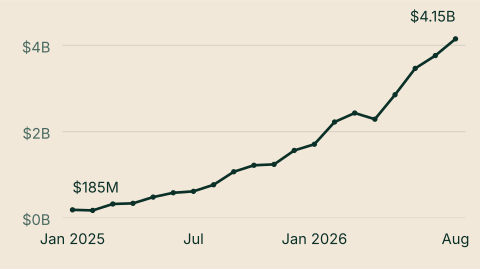
Monthly observations; excludes stablecoins. RWA.xyz, retrieved September 23, 2026. Chart data. Historical values may be revised.
Distribution and institutional adoption are growing. Robinhood has $186.5M in distributed RWAs; it also reported peak chain-wide gross revenue near $6M/day (September 9 update), not issuance revenue or a steady run rate. Canton records about $313B in represented assets as of September 23—largely Broadridge DLR, not available DeFi liquidity. Our earlier Canton work explored bringing eligible assets to Solana, subject to issuer approval and technical validation.
Regulation and infrastructure are opening the door. The SEC’s September 17 Innovation Exemption provides a temporary, conditional trading route for certain tokenized U.S. stocks; securities-law obligations still apply. Ika’s expected September launch gives us a reason to scope a pilot now.
How we would earn
Mint/redeem fees, plus recurring asset servicing and compliance-policy support. A model to test: $100K per issuer annually + 5 bps (0.05%) of combined mint/redeem volume, retained after partner shares.
| Issuers | Annual mint/redeem volume | Annual revenue |
|---|---|---|
| 10 | $2B | $2M |
| 25 | $5B | $5M |
| 25 | $15B | $10M |
The path to larger revenue is more issuers and repeat issuance/redemption. These are scenarios, not forecasts; before operating costs, excluding setup, cross-chain relocation and lending fees.
Reference points—not equivalent products:
- Backpack: about $0.50 to convert traditional holdings to tokens; no Backpack fee in reverse. Investor conversion pricing, not an issuer-platform tariff.
- Paxos PAXG: 12.5–50 bps redemption fees in marginal bands on rolling 30-day net redemptions. Creation fees waived through January 1, 2027.
- Securitize: $6.6M asset-servicing revenue in Q2 2026. Evidence of recurring demand; the filing does not establish a standard tariff.
Leads to explore
Metals: Metals.io for uranium, with copper to qualify. Uranium one-pager.
Commodity reserves: ARU, a floating-NAV reserve product.
Healthcare: Octave overview.
Previously explored leads, not committed customers.
Next steps
- Validate demand: speak with interested issuers about workflows, volumes and fees; choose a pilot and go-to-market plan.
- Align with Solana: seek ecosystem support and sign-off on the proposed pilot.
- Scope with Ika: resolve the architecture questions above, then agree the development plan, build and operating costs, and delivery ownership.